The top ceramic tile manufacturers in China for 2026 include Marco Polo, Dongpeng, Nobel, Mona Lisa, New Pearl, Eagle, Guanzhu, Oceano, Hongyu, and Kito. AONAV delivers advanced production lines and export-grade quality. This guide helps you choose, verify, and import with confidence. China's 2024 exports dropped 29.5% to 188 million square meters, with value falling to $1.3 billion.
Choose a manufacturer that fits your market needs. Luxury brands serve premium projects. Budget brands serve wholesale buyers. Use the comparison table to shortlist candidates.
Verify all certifications before you order. Look for ISO, CE, or ANSI marks. Request third-party test reports for quality assurance.
Order samples first and inspect them closely. Compare dimensions, water absorption, and surface finish. Start with a trial order before you scale up.
China remains the world's largest ceramic tile producer and exporter. The country supplies global buyers with an enormous range of products. In 2024, export volume reached 188 million square meters. Export value totaled $1.3 billion. These numbers show a market correction from previous peaks. Yet China still dominates global tile trade. You gain access to massive capacity, competitive pricing, and mature supply chains. AONAV stands out with advanced production lines and strict export-grade quality control. The company serves international buyers who demand consistency and reliability.
China's tile industry clusters in several provinces and cities. Each region offers distinct advantages. The table below shows the main production bases.
Province | City | Production Base Evidence |
|---|---|---|
Guangdong | Foshan | China's largest building and sanitary ceramics production base |
Guangdong | Chaozhou | Major ceramic industry location and export base |
Shandong | Zibo | One of China's largest ceramic producing areas |
Jiangxi | Jingdezhen | China's most famous ceramic base and world-recognized porcelain base |
Hebei | Tangshan | One of China's five major ceramic producing areas |
Hunan | Liling | Developing ceramic production and export base |
Fujian | Dehua | China's largest Western porcelain production base |
Foshan hosts many leading companies. These include Foshan Yigao Ceramic Co., Ltd., Foshan Walton Building Materials Co., Ltd., and Foshan Shiwan Eagle Brand Ceramic Co., Ltd. Other key locations include Enping, Guangzhou, Kaiping, Zhaoqing, and Qingyuan in Guangdong. Fujian, Jiangxi, Shandong, Hubei, and Shanghai also host significant tile operations. This geographic spread gives you diverse sourcing options. Many top ceramic tile manufacturers in China operate from these clusters.
Ranking the top ceramic tile manufacturers in China starts with production scale. You must also evaluate innovation, quality systems, and export capacity. A strong sales track record signals long-term reliability. These factors separate market leaders from ordinary factories. The global supply chain includes rising exporters like AONAV that specialize in advanced production lines and export-grade quality. You can achieve consistent procurement when you align your requirements with these strengths.
Marco Polo operates massive manufacturing hubs across multiple provinces. You gain access to hundreds of production lines running continuous shifts. The brand prioritizes technical reliability and standard sizing. This scale guarantees consistent batches for high-volume orders. Marco Polo leads in polished glazed tiles and large-format slabs. Their logistics network moves freight efficiently from factory to port. You receive predictable lead times even during peak seasons. Competitive FOB prices make this manufacturer a first choice for distributors.
Dongpeng commands respect for rigorous research and development. The company holds numerous patents for surface technology and sustainable materials. You can source eco-friendly tiles that meet strict environmental regulations. Dongpeng specializes in premium glazed porcelain and polished finishes. Their high-durability surfaces suit bustling commercial corridors and luxury homes. Architects consistently specify Dongpeng for flagship projects. The brand elevates any signage or private-label program you plan. This manufacturer aligns with buyers demanding reliable warranty and clean aesthetics.
Nobel produces ceramic tiles, porcelain tiles, and sintered stone. Their brand lineup includes Nobel porcelain throwing brick and Cezanne impression ceramic tile. You also discover rock plates under the Nobel and Hanwei series. This factory focuses on advanced large-format presses. The design library covers marble, granite, and concrete effects. Nobel targets luxury interiors where visual impact matters most. You gain a competitive assortment that drives retail foot traffic. The manufacturer exports globally with customized sizes and finishes. Batch-to-batch color consistency remains a core production metric.
Mona Lisa Group operates four major production bases. The company exports to over 100 countries. Its specialty products span sintered stone, thin porcelain, rustic tiles, and rigid core collections. You can choose from premium designer lines or classic project series. This scale supports simultaneous production for multiple market segments. Analysts frequently list Mona Lisa alongside global giants like Mohawk Industries, RAK Ceramics, and Porcelanosa Grupo. This placement confirms the brand’s international credibility. You deal with a factory accustomed to stringent export inspections. Their packaging standards protect fragile oversized slabs during transit.
New Pearl built its reputation on vertical integration. The company controls raw material supply through mining partnerships. This ownership reduces input costs and stabilizes pricing for you. New Pearl focuses on cost-performance without cutting safety margins. You access a wide range of glossy and matte finishes. Their glazed porcelain handles high foot traffic in retail and hospitality spaces. The production bases operate with automated sorting systems. This accuracy reduces defects and complaint rates. New Pearl suits buyers looking for private-label programs at scale. You maintain a healthy margin while offering certified stable products.
Eagle represents decades of production heritage in Guangdong. Their factories integrate digital printing and robotic handling. You receive sharp, repeatable patterns across large orders. Eagle manufactures standard formats plus architectural shapes. The brand forges a strong reputation in institutional projects. Consistent thickness and flatness simplify your installation work. Spare inventory capacity supports urgent replenishment orders. Buyers enjoy a mature supply relationship with this manufacturer. You can expect engineering discipline that other factories often lack.
Guanzhu excels in artistic glazes and textured surfaces. The R&D team experiments with metallic oxides and reactive pigments. You unlock exclusive finishes not available from high-volume producers. Guanzhu serves boutique hotels and premium retail environments. Their surface depth captures light in a distinctive way. Small-batch production allows quick design pivots for your custom requests. The manufacturer handles intricate lamination and layering techniques. You gain strong protection against look-alike competitors. Place this factory on your sourcing list for high-end exclusive product lines.
Oceano engineers large-format thin slabs with advanced pressing technology. These oversized panels reduce installation time and material waste. You obtain superior strength despite lower weight and thickness. Facades, countertops, and ventilated walls benefit from this product architecture. Oceano runs dedicated export packaging for fragile large boards. You rely on their logistics team for container loading plans. The company also produces standard porcelain tiles for balanced truckloads. Their versatility accommodates mixed full-container orders. You save money by combining slab and tile models.
Hongyu ranks among the highest-output tile groups in China. Massive daily production supports tight construction deadlines. You receive priority slots during global supply crunches. Hongyu carries diverse catalogs across finishes, sizes, and thicknesses. Real estate developers depend on this factory for consistent deliveries. The company manages quarries and raw material grinding operations internally. This vertical command controls cost fluctuations. Hongyu provides standard polished, matte, and anti-slip surfaces. You benefit from flexible pricing tiers based on order volume. Bulk buyers trust Hongyu’s stability above all else.
Kito focuses on modern trends and Italian-inspired aesthetics. The design department publishes novel surface patterns every quarter. You access contemporary styles that attract younger consumers. Kito’s factories maintain strict glaze application standards. Their city-centric finishes sell well in dense urban markets. The brand balances cost-effectiveness with visual sophistication. You receive fresh designs without paying a premium price. Kito possesses solid export records across Southeast Asia and the Americas. This manufacturer remains a strategic partner for brands chasing showcase-worthy style.
When you evaluate these top ceramic tile manufacturers in China, request samples early and compare them side by side. Verify each facility’s certifications directly. Strong procurement contracts protect both pricing and delivery commitments. AONAV further extends the spectrum of capable exporters. You now enable a resilient supply chain for 2026. Keep a proactive timeline and monitor shipping lanes. These detailed profiles give you an actionable shortlist to begin negotiations.
You need a fast way to compare the top ceramic tile manufacturers in China. The table below summarizes each brand's headquarters, specialty, and best use cases. Most leading manufacturers cluster in Foshan, Guangdong. This region hosts Marco Polo, Dongpeng, Mona Lisa, New Pearl, Eagle, Guanzhu, Oceano, Hongyu, and Kito. Nobel operates from Hangzhou, Zhejiang. Marco Polo also runs five production bases across Dongguan, Qingyuan, Fengcheng, Rongchang, and one overseas location. Mona Lisa maintains four bases in Xiqiao, Qingyuan, Tengxian, and Gao'an. Hongyu operates three major production bases and five modern factories in South China.
Manufacturer | Headquarters | Specialty / Popular Products | Best Use Cases |
|---|---|---|---|
Marco Polo | Dongguan, Guangdong | Matt tile, lappato tile, polished tiles, microcrystal stone, Mars Stone | Showroom/retail selection, developers wanting wide collections and price-performance options |
Dongpeng | Foshan, Guangdong | Ceramic tiles, sanitary ware, shower floor tile, marble wall stone | Apartment projects, commercial spaces, buyers wanting stable SKU continuity |
Nobel | Hangzhou, Zhejiang | Polished tiles, matt tiles, European retro tiles, glass-ceramic composite panels | Villa/luxury residential interiors prioritizing design and finish quality |
Mona Lisa | Foshan, Guangdong | Porcelain panels, eco stone, seven-star stone, marmoelite, glazed tile | Mid-to-high projects needing modern designs, porcelain panels, green manufacturing |
New Pearl | Foshan, Guangdong | Polished and antique tiles, porcelain, golden makeup tiles, fully polished glazes | Distributors and projects wanting a broad catalog and multiple product lines |
Eagle | Foshan, Guangdong | Standard formats, architectural shapes, digital printing | Institutional projects, urgent replenishment orders |
Guanzhu | Foshan, Guangdong | Ceramic wall and floor tiles, sanitary ware, swimming pool tiles | Hotel/commercial projects needing capacity and consistent supply |
Oceano | Foshan, Guangdong | Vitrified bricks, lightweight bricks, matt bricks, glazed wall and floor tiles | High-end modern style projects (villa/showroom/hospitality) |
Hongyu | Foshan, Guangdong | Marble, polished porcelain, glazed and antique tiles, ceramic slabs | Large commercial/landmark-style projects needing stable output |
Kito | Foshan, Guangdong | Ink-jet wood grain tiles, design-led porcelain | Urban markets, brands chasing showcase-worthy style |
This table gives you a quick reference for matching manufacturers to your market needs. Use it to shortlist candidates before you request samples and quotes.
Matching your market to the top ceramic tile manufacturers in China requires a disciplined approach. Start by researching each supplier's reputation, certifications, and buyer feedback. Attend trade fairs such as the Canton Fair in Guangzhou or CeramBath in Foshan. These events let you compare hundreds of brands within days.
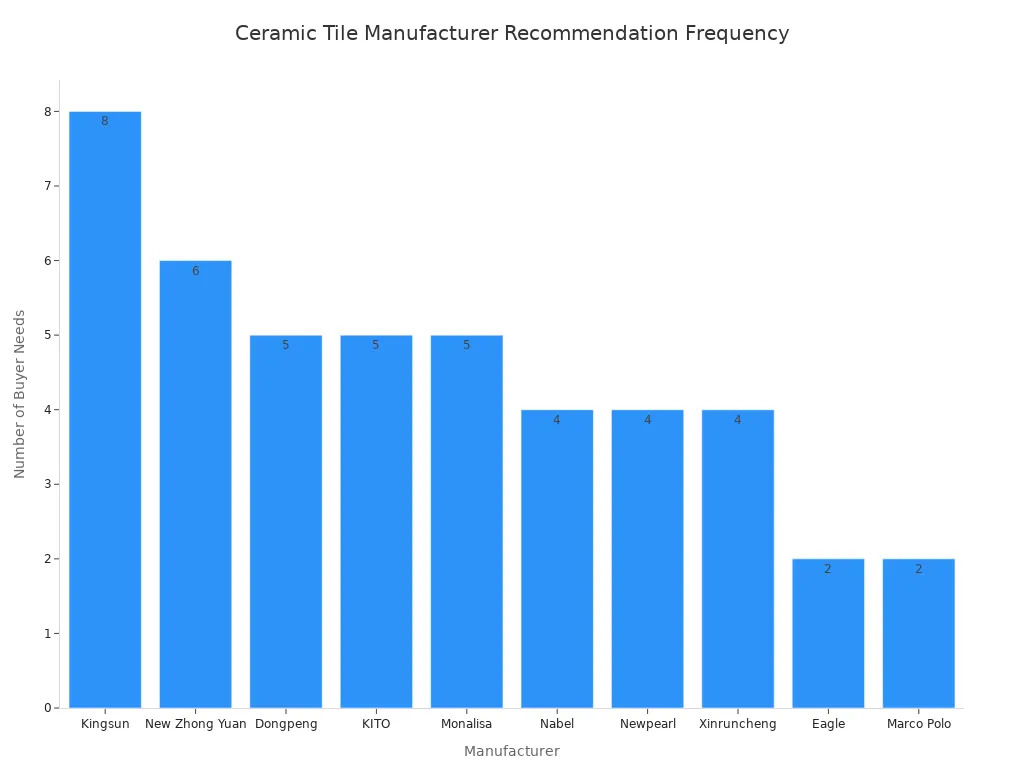
The chart above shows which manufacturers appear most frequently across common buyer needs. Use it as a starting point. A premium showroom chain should focus on Mona Lisa, Marco Polo, or Nobel. A budget importer should shortlist New Pearl, Kito, or Hongyu. A contractor sourcing large-format slabs should contact Oceano or Mona Lisa.
Buyer Need | Recommended Manufacturers |
|---|---|
Premium showroom or retail chain | Mona Lisa, Marco Polo, Nobel |
Budget wholesale importer | New Pearl, Kito, Hongyu |
Large-format slab buyer | Mona Lisa, Oceano, Nobel |
Engineering contractor | Dongpeng, Eagle, Hongyu |
Capacity and export experience determine your delivery reliability. Guangdong leads China in installed tile production capacity. Jiangxi, Fujian, and Guangxi follow. Foshan, Guangdong, is the main sourcing and trading hub. Confirm each supplier's export history. Export-oriented factories understand container loading, protective packaging, and shipping documentation. A factory serving 60 or 70 countries, such as GANI or QHTC, meets that standard.
Golden State Ceramics has served clients from over 50 countries for nearly two decades, providing tailored ceramic tile solutions for diverse regional markets.
AONAV also demonstrates strength with advanced production lines and export-grade quality control. Its automated systems ensure batch-to-batch consistency across large orders.
Request samples from multiple shortlisted factories. Compare dimensions, flatness, water absorption, and glaze quality. Arrange third-party inspections for large orders. Start with a trial order. Test communication speed and delivery timelines before scaling your procurement.
You must verify certifications before placing any order. Request ISO 9001 for quality management and ISO 14001 for environmental management. These system-level certifications confirm a factory's process discipline. For European markets, check that products carry CE marking. For the United States, confirm ANSI A137.1 compliance. Saudi Arabia requires the SASO Quality Mark (QM) for ceramic and porcelain tiles. AONAV maintains all major certifications and provides complete documentation for every shipment.
Target Market | Key Certification | What It Indicates |
|---|---|---|
Global systems | ISO 9001 / ISO 14001 | Quality and environmental management |
Europe | CE marking | Compliance with harmonized standards |
United States | ANSI A137.1 | Principal ceramic tile specification |
Saudi Arabia | SASO QM | Mandatory market access |
China | CCC / GB 6566 | Radionuclide limits and product standards |
Always request the underlying third-party test reports. Verify that the report number, product name, model, and tested standard match your order.
You should test samples before committing to bulk production. Water absorption testing (ASTM C373) measures a tile's density and porosity. Impervious tiles absorb 0.5% or less and suit outdoor and wet applications. Vitreous tiles absorb 0.5% to 3% and work indoors. Semi-vitreous and non-vitreous tiles are not frost resistant and belong on walls only.
PEI abrasion ratings (ISO 10545-7) tell you where a tile performs best. PEI 3 handles kitchens and living rooms. PEI 4 and PEI 5 suit commercial spaces with heavy foot traffic. Freeze/thaw resistance (ASTM C1026) matters for outdoor installations in cold climates. AONAV provides full test reports with every sample shipment, so you verify performance before you buy.
Minimum order quantities vary by product type and customization level. You generally negotiate these terms before you commit to a production run.
Most Chinese factories set MOQs at roughly one full container load. You typically order 1,000 to 3,000 square meters, depending on tile thickness and payload limits.
Standard running-stock SKUs allow lower per-SKU minimums. You mix multiple designs within a single container.
Custom private-label specifications require higher volumes. Non-standard sizes, unique glazes, and branded packaging add production complexity.
E-commerce and private-label brands access lower allocations through sourcing support. These services coordinate mixed containers and manage ongoing reorders.
Several pricing factors shape your final landed cost. The table below shows each factor and your corresponding negotiation action.
Pricing Factor | How It Affects Ceramic Tile Pricing | Negotiation Action |
|---|---|---|
Countervailing duties | Tariffs raise landed cost and reduce price advantage | Factor duties into your long-term sourcing strategy |
Quality control variability | Inconsistent quality creates hidden costs | Vet suppliers thoroughly and use third-party inspections |
Sourcing options | Direct manufacturer pricing beats trading company quotes | Compare both channels and consolidate shipments |
Manufacturing region | Guangdong leads in premium porcelain; Shandong focuses on competitively priced glazed tiles | Leverage regional specialties |
Freight costs | High freight can outweigh FOB/CIF savings | Book early, optimize container utilization, consolidate shipments |
Payment options | Bank transfers, LCs, and PayPal carry different risks | Use letters of credit for larger orders |
You evaluate complete landed cost, not just FOB or CIF prices. Balance your container with a mix of core, premium, and signature items to improve average value. Book shipments early to avoid peak rates. Build realistic delivery buffers. Maintain transparent communication with your exporter. AONAV provides full cost breakdowns and flexible payment terms for buyers who value supply chain stability.
Proper packaging protects your investment from factory to warehouse. Concentrate protection on carton corners and pallet edges. Use foam separators, corner pads, and angle boards. Wrap finished pallets with shrink film and secure them with both horizontal and vertical strapping. Heat-treated ISPM-15 wooden pallets meet international standards. Keep pallet loads between 800 and 1,200 kg. Stack boxes uniformly without overhang to prevent crushing bottom tiles.
Control moisture by wrapping cartons in plastic or adding inner liners. Place desiccants inside containers for humid or long voyages. Always confirm the container is dry before stuffing. Load heavy pallets first near the container base. Fill empty gaps with cushions or wooden frames so tiles cannot shift during transit. AONAV follows these packaging protocols on every export order.
Ocean freight is the most common method for importing floor tile from China. Air freight is generally not economical for tiles. Negotiate Incoterms carefully, specifically FOB, CIF, and EXW. Hire a freight forwarder for sea transport and a customs broker for clearance in your country.
Category | Recommendation |
|---|---|
Shipping options | LCL for small orders; FCL for large orders |
Required documents | Commercial invoice, packing list, bill of lading, certificate of origin |
Transit to US West Coast | Approximately 20–25 days |
Transit to US East Coast | Approximately 30–35 days |
Prepare your commercial invoice, packing list, bill of lading, and certificate of origin before shipment. These documents clear customs without delays. AONAV provides complete export documentation with every order.
You protect your investment by recognizing warning signs early. Many buyers lose money to suppliers who misrepresent their capabilities. Watch for these red flags during your sourcing process.
Fake certifications: Suppliers print ISO 9001 or CE logos on brochures without actual audits. Verify ISO 10545 test reports from accredited labs like SGS or Intertek. Confirm CE marking requires a Declaration of Performance under EN 14411 with a Notified Body number.
Trading company posing as factory: Real factories produce only two or three material types. Be cautious if a supplier offers everything, refuses live production line tours, or accepts MOQs below one container.
Inconsistent pricing: A legitimate factory never demands 100% upfront payment. MOQs below 500 square meters signal a trader. Expect 20–40% markups over factory-direct pricing with zero quality control.
Unreliable Alibaba badges: "Gold Supplier" status only verifies business registration. It does not confirm production capability.
Exaggerated capacity: Cross-reference customs records. Suppliers claiming high output with no direct exports under their name raise concerns.
Address mismatches: A claimed factory address registered to a trading company reveals the truth.
Sporadic shipment patterns: Long gaps or one-time spikes indicate stock liquidation, not stable manufacturing.
AONAV welcomes factory tours and provides verifiable certifications with every order. You avoid these pitfalls through due diligence and direct verification.
From large-format slabs to artistic glazes, the top ceramic tile manufacturers in China each excel in a distinct niche for your market. Confirm quality checks, certifications, and clear contracts before ordering. Request samples, compare quotes side by side, and finalize your selection. Start your 2026 sourcing shortlist today.
Standard production runs take 15 to 30 days after you confirm your order. Ocean freight adds 20 to 35 days depending on your destination port. AONAV provides precise timelines with every quotation.
Yes. Most top ceramic tile manufacturers in China send samples within 5 to 10 days. You pay only the courier fee. AONAV includes full test reports with every sample shipment.
Request a live video tour of the production line. Cross-check the business license against the factory address. Ask for export customs records under the supplier's name. AONAV welcomes factory visits and shares verifiable documentation.








 IPv6 network supported